How I Got My Natural Hair Color Back After Highlights
Natural Hair Color
If you're wondering how to go back to natural hair color after highlights, I have good news: you don't need another complicated color correction, expensive salon treatment, or endless cycle of dyeing your roots.
You may just need patience.
I know that's probably not the exciting answer you're looking for.
But after a decade of highlighting, bleaching, box dyeing, going dark, going blonde again, and generally doing just about everything I could possibly do to my hair, I eventually decided to stop coloring it altogether.
And honestly?
It was the best thing I ever did for my hair.
It took me about two years to completely grow out all of my color-treated hair. But when I finally reached the end of that journey, I had thick, full, healthy-looking hair that I was genuinely proud of.
So if you're sitting there staring at your grown-out highlights wondering whether you should just give up and dye everything again, this is your sign to hang in there a little longer.
The only way out is through.
My hair color journey started way earlier than it needed to
I started coloring my hair in sixth grade.
Yes. Sixth grade.
I started with very subtle blonde highlights, which seemed innocent enough at the time. But gradually, those subtle highlights became more and more blonde.
By the time I was in junior high, I was bleaching my entire head.
I still can't believe I ever did that.
But I did.
Eventually, the bleach-blonde look felt like too much for me, so I added lowlights and transitioned back toward a highlighted—but still very blonde—look.
And then high school happened.
By that point, my hair was so brittle and thin that I honestly thought I just had naturally thin hair.
Looking back, I now realize I was putting my hair through years of chemical processing, causing so much unnecessary damage.
And I was nowhere near finished with my hair-color experimentation.

Blonde Highlights
Then I decided to dye my hair dark
When I was in college, I was still highlighting my hair.
Around my junior year, I had the brilliant idea to dye my hair light brown.
So I went to the store with my cousin and bought a box of "light brown" hair dye.
We went home, dyed my hair, and...it was basically just a slightly darker blonde shade...not quite what I was hoping for.
So we went back to the store and figured we would try a box of "darkest brown"... I'm sure you can guess how this turned out.
It was basically black.
And because some of my blonde hair was still peeking through (in patches), I decided I needed another box.
So I did another box.
Woah.
Eventually, after a month or so, that darkest brown started fading.
But it wasn't fading into the pretty natural brown I had imagined.
It started fading in a weird, greenish way.
Not good.
So, naturally, my solution was to get highlights again. Which turned out kinda orangish?
Yikes.
Looking back at my hair color journey, it really was a cycle.
Lighter shade.
Darker shade.
Lighten it again.
Try to fix it.
Repeat.
And eventually I just got tired of it.

Highlights Post “Darkest Brown” Box Dye
I finally decided to stop coloring my hair
This was around the same time that I started becoming much more intentional about the products and choices I was making in my life.
I was becoming more interested in non-toxic living, sustainability, and simplifying the things I was bringing into my life.
And suddenly, spending hours and money maintaining a hair color that wasn't even my natural color didn't seem nearly as appealing.
So I decided to stop.
Completely.
No more highlights.
No more bleach.
No more box dye.
No more trying to find the perfect shade to cover up the last shade.
I was going to grow out my natural hair color.
And this is where my advice gets incredibly simple.
How to go back to natural hair color after highlights
My answer is probably much less exciting than what you might be hoping for.
Grow it out.
That's it.
If you want to truly return to your original hair color, the hair that has already been highlighted or bleached cannot simply turn back into your natural color.
Your natural color will grow from your roots.
The treated portion remains treated until it grows out and is eventually cut off.
So you have two basic options:
Grow out your natural roots and gradually cut away the colored hair.
Have a professional color your existing hair closer to your natural shade, then grow it out from there.
For me, I chose the first option.
And while it took time, it was absolutely worth it.
As I started learning more about what was in the products I was using, I also became more interested in reducing unnecessary chemical use in my routine. If you're curious about some of the concerns surrounding ingredients in conventional hair-coloring products, the Environmental Working Group has a helpful overview of hair dye ingredients and potential health concerns.
And if growing out my natural hair taught me anything, it’s that sometimes simplifying is the best choice. If you’re looking for other ways to make more intentional, non-toxic changes without trying to do everything at once, check out my guide on how to transition to a non-toxic home without overwhelm.
The hardest part is the beginning
If you're growing out highlights right now, you probably know exactly what I'm talking about.
At first, your natural roots start appearing.
And then they become obvious.
Really obvious.
This is the stage where you are most likely to panic and schedule another appointment.
Don't.
Or at least, don't assume that you have to.
This is the hardest part of growing out your natural hair color because the contrast between your natural roots and your blonde hair (or whatever color your treated hair is) can be so noticeable.
You might look in the mirror and think:
"Okay, this was a terrible idea."
I promise, you're not alone.
But hang in there.
Eventually, the natural roots grow farther down and the contrast starts to soften.
Your hair may start looking almost like a balayage.
Maybe that's not your favorite look.
It wasn't mine either.
But it's temporary.
And that was something I had to keep reminding myself.
Eventually, the grow-out starts looking intentional
This was one of the biggest mental shifts for me.
At first, I felt like I was walking around with grown-out highlights.
Eventually, I started thinking of it as my natural hair growing in.
There's a difference.
The color doesn't suddenly become perfect overnight. You just reach a point where the transition doesn't bother you nearly as much.
And then one day, you realize that most of the hair you're looking at is actually your own natural shade.
That was such a good feeling for me.

1.5 Years Into Grow Out
How long does it take to grow out highlighted hair?
For me, it took about two years to completely grow out all of my color-treated hair.
My hair was around mid-back length, so there was a lot of colored hair to get through.
Your timeline may be completely different.
It depends on things like:
How long your hair is (short hair would probably take half the time)
How quickly your hair grows
How much of your hair has been colored
How often you trim it
Whether you're willing to cut off the treated ends
Whether you're starting with highlights, balayage, or all-over color
You're waiting for new, untreated hair to grow in.
That's why patience is such a big part of this process.
What if the difference between your natural color and highlights is really dramatic?
This is where I think a professional colorist can be a great option.
You definitely don't have to go from bright blonde to months of very obvious roots if you don't want to.
If the difference between your natural shade and your highlighted hair is stark, you can talk with a professional hairstylist about bringing the colored portion closer to your natural color.
For example, someone with dark brown natural hair and very blonde highlights may feel much more comfortable having the blonde toned or colored closer to their natural shade before beginning the grow-out process.
The goal isn't necessarily to make the entire head perfectly identical to your natural color.
It's to make the transition easier to live with. And sometimes the best way to do that is by finding a starting point that makes you feel comfortable!
I would skip the box dye this time
I say this as someone who has personally purchased multiple boxes of "darkest brown" and then needed to deal with the consequences.
Please learn from my mistakes.
If you're trying to transition back to your natural color, I'd rather see you talk with a professional colorist than repeatedly experiment with box dyes.
Especially if you have:
Previously bleached hair
Blonde highlights
Multiple layers of old color
Uneven color
Significant damage
A big difference between your natural shade and your current color
Color correction can become complicated because your hair may have different levels of porosity and different underlying pigments throughout the lengths.
That's exactly the kind of situation where professional experience can be worth it.
When I finally went back to my colorist (after that box dye incident...) she graciously explained that my hair had endured some severe damage from the low-quality dyes (x 3 boxes...oops!), so she had to be extra careful. All this to say, if you are in a situation similar to mine and want to blend your color before starting the grow out process, I would recommend leaving it to a hair expert.
What about using demi-permanent or semi-permanent color?
A demi-permanent or semi-permanent hair color can be an option for someone who wants to make the transition less noticeable without committing to permanent color.
But it will eventually fade, and the previously lightened hair is still chemically treated underneath.
If your ultimate goal is to stop coloring your hair completely, every additional coloring service is another step you may eventually have to grow out.
That's why I personally chose the simplest route of just growing it out.
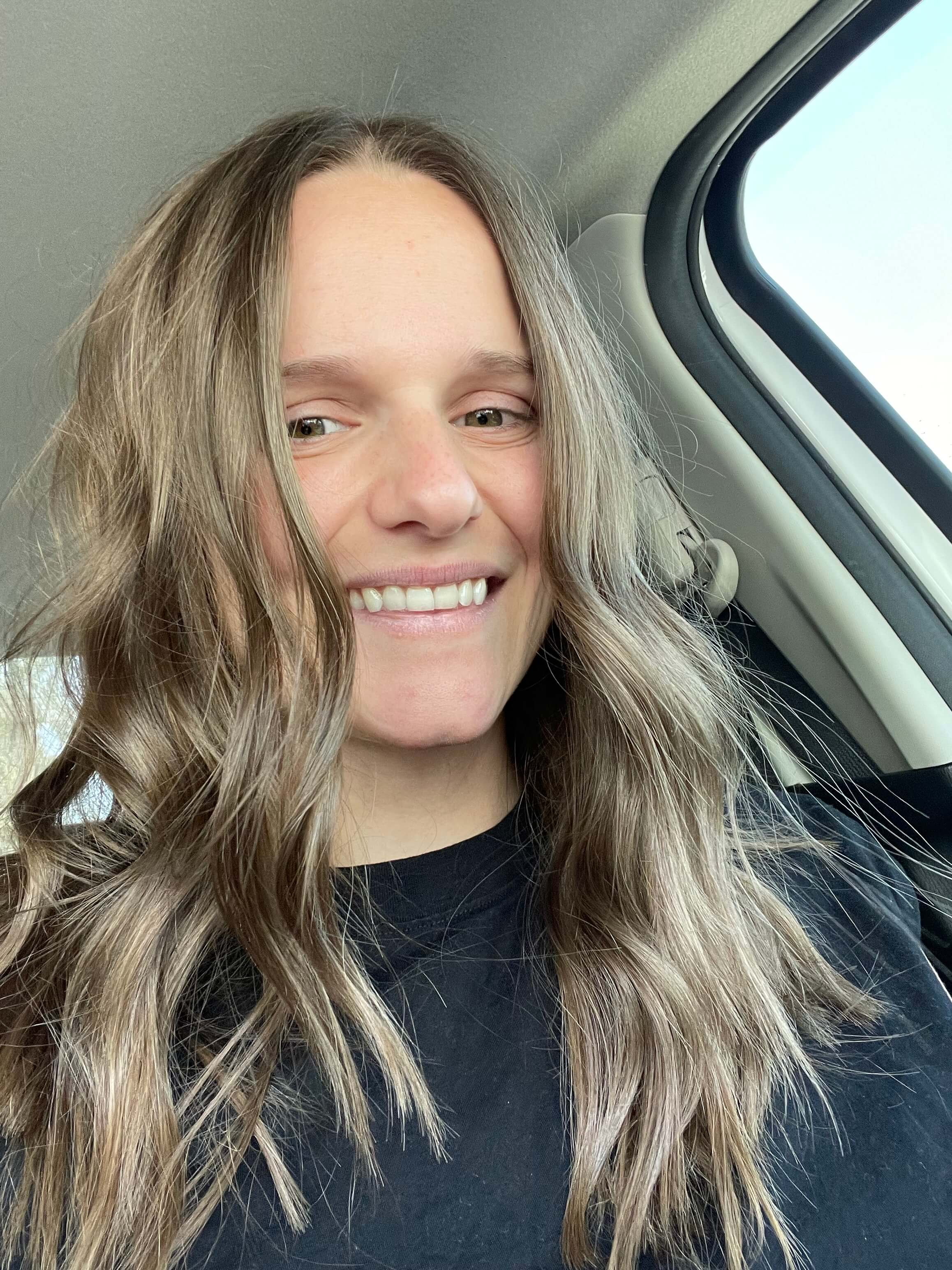
My hair after growing everything out
This is the part that makes me so glad I stuck with it.
After approximately two years, I had finally grown out all of my color-treated hair.
And my hair looked completely different.
It was thick.
It was full.
It looked healthy.
And because I had spent so many years thinking my hair was naturally thin and brittle, seeing the difference was honestly shocking.
Now, I don't want to make a blanket promise that quitting hair color will make everyone's hair thicker. Hair density and hair growth are affected by many different factors.
But in my own experience, eliminating all of that repeated coloring and lightening made a huge difference in how my hair looked and felt.
I fell in love with my hair's natural tone and finally had the healthy hair I always wanted.
You don't need a complicated hair-growth routine
One thing I love about growing out your natural hair is that you don't need to turn it into a huge project.
You don't need five different products.
You don't need a complicated routine.
You really just need to let your hair grow.
Of course, taking good care of your hair can help minimize breakage while you're waiting. Gentle washing and conditioning, limiting excessive heat, and avoiding rough handling are all reasonable ways to care for fragile hair.
But the most important part?
Don't undo your progress because you're temporarily feeling impatient.
I know that is much easier said than done.
Growing out my natural color also made me rethink the rest of my hair-care routine, from the products I used to the tools I reached for every day. If you're looking for some simple swaps, check out my roundup of eco-friendly hair brushes, combs, and accessories.
The hardest part is temporary
If you're currently in the awkward stage, I want you to remember something:
This is temporary.
Your roots will keep growing.
Your natural shade will become more prominent.
The colored portion will move farther and farther down.
Eventually, you'll have a lot more natural hair than highlighted hair.
And eventually, the highlighted hair will be gone.
When I was in the middle of my grow-out, two years sounded like an incredibly long time.
But two years passed.
They always do.
And at the end of those two years, I had my natural hair color again.
What I would do differently if I were starting over
Honestly?
I would stop much sooner.
I spent years trying to find the right hair color when I already had one growing naturally out of my head. I don't think I ever really even enjoyed dying my hair. I think I just did it because, at some point, it had become part of my routine.
Looking back, I also think I would have considered cutting my hair short much sooner.
After I had finally grown out all of my color-treated hair, I eventually cut my hair to about shoulder length—and I loved it. It was such a fun change, and it made me realize that I probably could have done the same thing during my grow-out process.
If I had cut my hair shorter at the beginning, I could have gotten rid of a huge portion of my color-treated hair much sooner and potentially cut the grow-out time nearly in half.
Of course, not everyone wants short hair, and I definitely understand wanting to keep your length. But if you're on the fence about a shorter haircut, growing out your natural color might actually be the perfect excuse to try it.
If you're reading this because you're tired of highlights, tired of covering your roots, tired of trying new shades, or simply curious about what your natural hair color looks like now, you don't have to make the decision forever.
You can just stop coloring it and see what happens.
And if you decide six months from now that you hate it, you can always change it.
But you might be surprised by how much you love your natural hair once you give yourself the opportunity to actually see it.

Short Hair Post Growing Out My Color-Treated Hair
What if you really don't want to grow out your highlights?
That's okay, too.
I'm not here to convince everyone that natural hair color is better.
If you love your blonde hair, keep it.
If highlights make you feel great, there's nothing wrong with that.
My hope with this post is simply to encourage anyone who is thinking about coming to the end of a coloring journey that you can do it.
And if the grow-out process feels overwhelming, you can make the transition easier by working with a professional colorist to choose a shade closer to your natural color.
A simple plan for growing out your natural hair color
If you're ready to give it a try, here's exactly how I'd approach it.
1. Decide that you're actually done
This is the first step, and probably the most important step.
If you're constantly thinking, "I'll grow it out unless I hate the roots," you're much more likely to color it again during the awkward stage.
Commit to giving your natural color a real chance.
2. Let your roots grow
This is the boring part.
Let them grow.
Don't panic when the contrast becomes noticeable.
Remember that the awkward stage is part of the process.
3. Consider a professional color match if needed
If your current color is dramatically different from your natural shade, a professional can help create a more natural-looking transition.
This may be especially helpful if the gradual approach is making you second guess yourself.
4. Get regular trims
Regular trims can gradually remove the old color while allowing your natural hair to get longer.
This might sound obvious, but seeing those color-treated ends come off feels so great during the grow-out process!
5. Be gentle with your hair
Condition your hair, be gentle when detangling, and limit excessive heat.
6. Don't give up during the awkward stage
This is the big one.
You will probably reach a point where you don't love your hair.
Keep going.
Eventually, it starts looking less like "grown-out highlights" and more like your actual hair.
The best part of going back to your natural hair color
For me, it wasn't just having my natural shade back.
It was being done.
Done with the appointments.
Done with the roots.
My hair could just be my hair.
And after years of coloring it, that felt incredibly freeing.
It also fit perfectly with the way I was beginning to think about the rest of my life: buying less, simplifying my routines, choosing more intentionally, and being more conscious about what I was using.
Sometimes the most sustainable beauty choice is simply using less.
Natural Hair Color
Final thoughts: You really can grow out your natural hair
If you're wondering how to go back to natural hair color after highlights, my personal answer is very simple:
Stop coloring it and let it grow.
It won't happen overnight.
You may not love the way your hair looks during the first several months.
You may have a stage where your natural roots are obvious and your hair looks like a grown-out balayage.
Hang in there.
For me, the entire process took about two years, but it was absolutely worth it.
My hair is now thick, full, and healthy-looking, and I would make the same decision again in a heartbeat.
If you're tired of constantly maintaining your hair color, I hope my story encourages you to give your natural hair a chance.
You don't have to do anything dramatic.
You just need some patience.
The only way out is through.
And someday, you'll look in the mirror and realize that the hair you've been waiting for is finally all yours.
Frequently Asked Questions About Going Back to Natural Hair Color After Highlights
Can you go back to your natural hair color after highlights?
Absolutely! Your natural color grows in from the roots, so you either need to grow out the highlights or have the treated hair professionally colored closer to your natural hue.
How long does it take to grow out highlighted hair?
It depends on your hair growth, length, how much hair has been highlighted, and how often you trim it. In my case, it took about two years to completely grow out my color-treated hair.
Should I dye my hair back to its natural color or grow it out?
If you're ready to stop coloring your hair completely, growing it out is the simplest option. If the contrast between your natural roots and highlighted lengths is difficult to live with, a professional colorist can help create a closer, more natural-looking transition first. Hair color journeys are unique to each of us, and whatever feels the most comfortable to you is what I recommend!
Can I use semi-permanent hair color to cover my highlights?
A semi-permanent or demi-permanent color may help blend highlighted hair with your natural shade. The color will eventually fade, and you'll still need to grow out the treated hair if your ultimate goal is completely natural hair.
Will my hair get healthier if I stop highlighting it?
Reducing chemical processing can reduce one source of damage and breakage, although hair health depends on many factors. Bleaching and lightening can make hair more fragile, so eliminating those services may help your hair retain more length and look healthier over time.
In my own experience, when I stopped coloring my hair entirely, I had drastically healthier and fuller hair.
What should I do during the awkward grow-out stage?
Keep going. Your natural roots will eventually make up more of your hair, and regular trims can gradually remove the highlighted ends. If the contrast is particularly strong, consider asking a hair colorist about a closer-to-natural color.
Latest on the blog